|
 A
Collaboration Like No Other
Petula and Dee Shipman's partnership was more than prolific,
it was profoundly personal, artistically daring, and quietly
historic. Over four decades, they co-wrote more than fifty songs
spanning studio albums and stage musicals, forming the most
extensive co-writing relationship of Petula's career. From the
sweeping theatrical ambition of Someone Like You to the haunting
lyricism of Zola, their work reflects a rare synergy between
composer and lyricist, one rooted in mutual respect, melodic
intuition, and emotional truth. This page celebrates their
enduring legacy: a body of work that not only enriched Petula's
repertoire but expanded the very definition of her artistry. Read
more>> A
Collaboration Like No Other
Petula and Dee Shipman's partnership was more than prolific,
it was profoundly personal, artistically daring, and quietly
historic. Over four decades, they co-wrote more than fifty songs
spanning studio albums and stage musicals, forming the most
extensive co-writing relationship of Petula's career. From the
sweeping theatrical ambition of Someone Like You to the haunting
lyricism of Zola, their work reflects a rare synergy between
composer and lyricist, one rooted in mutual respect, melodic
intuition, and emotional truth. This page celebrates their
enduring legacy: a body of work that not only enriched Petula's
repertoire but expanded the very definition of her artistry. Read
more>>
 The
Composer Behind the Voice Beyond the spotlight and
chart-topping hits, Petula has quietly built one of the most
diverse and personal songwriting catalogues in popular music.
With over 200 original compositions to her name, including film
scores, stage musicals, international singles, and deeply
introspective ballads, Petula's creative voice is unmistakable.
Her melodies are intuitive, her lyrics often autobiographical,
and her approach refreshingly unforced. Whether writing alone or
in collaboration, she has crafted songs that speak to joy,
longing, resilience, and reflection. This page offers a glimpse
into that rich legacy, an archive of works that reveal the
artist behind the performer, and the quiet brilliance of a
composer who always let the music speak first. Read
more>> The
Composer Behind the Voice Beyond the spotlight and
chart-topping hits, Petula has quietly built one of the most
diverse and personal songwriting catalogues in popular music.
With over 200 original compositions to her name, including film
scores, stage musicals, international singles, and deeply
introspective ballads, Petula's creative voice is unmistakable.
Her melodies are intuitive, her lyrics often autobiographical,
and her approach refreshingly unforced. Whether writing alone or
in collaboration, she has crafted songs that speak to joy,
longing, resilience, and reflection. This page offers a glimpse
into that rich legacy, an archive of works that reveal the
artist behind the performer, and the quiet brilliance of a
composer who always let the music speak first. Read
more>>
 Petula's Moments in the Woods: A Journey Through Song, Stage, and Sondheim This page explores Petula's, decades-spanning connection to Stephen Sondheim's music, through rare recordings, live performances, and heartfelt tributes, revealing a quiet but powerful artistic affinity with his work, even though she never starred in one of his musicals.
Read more>> Petula's Moments in the Woods: A Journey Through Song, Stage, and Sondheim This page explores Petula's, decades-spanning connection to Stephen Sondheim's music, through rare recordings, live performances, and heartfelt tributes, revealing a quiet but powerful artistic affinity with his work, even though she never starred in one of his musicals.
Read more>>
 Still on Wax: Spotlighting Vinyl Treasures Still Awaiting CD Release
This page highlights a curated list of Petula's vinyl-era recordings that have yet to be released on CD or made available on digital platforms. It focuses on officially issued tracks, excluding demos and recent archival releases, and includes rare album cuts, alternate single mixes, and unique collaborations spanning from the early 1970s to the late 1980s. Each entry is annotated with historical context, offering fans a detailed look at these more elusive recordings.
Read more>> Still on Wax: Spotlighting Vinyl Treasures Still Awaiting CD Release
This page highlights a curated list of Petula's vinyl-era recordings that have yet to be released on CD or made available on digital platforms. It focuses on officially issued tracks, excluding demos and recent archival releases, and includes rare album cuts, alternate single mixes, and unique collaborations spanning from the early 1970s to the late 1980s. Each entry is annotated with historical context, offering fans a detailed look at these more elusive recordings.
Read more>>
 Unboxed: The Definitive Guide to Petula's Polydor Studio Recordings Unboxed: The Definitive Guide to Petula's Polydor Studio Recordings
This page offers the first fully structured exploration of Petula's Polydor-era studio recordings, covering the years 1972-1975. It traces the creation of four albums: Now, Come On Home, I'm The Woman You Need, and Just Petula, alongside their associated singles, sessions, international variants, and critical reception. Drawing on detailed research, it highlights how shifting labels, transatlantic recording schedules, and evolving industry priorities shaped this period, while emphasising the exceptional quality of Petula's vocal work. The page also documents rare pressings, live performances, unreleased material, and the complexities of cassette sequencing. For collectors, it serves as a comprehensive guide to one of the richest and most overlooked chapters of Petula's recording career, celebrating her Polydor years.
Read more>>
 The Lost Demo Album • The Broadway Years • The Great
"What-If" Project The Lost Demo Album • The Broadway Years • The Great
"What-If" Project
The New York Sessions document a set of industry‑only demos recorded in 1994 during Petula
’s Broadway run in Blood Brothers. Intended for internal review rather than commercial release, the recordings present a full, sequenced programme of contemporary theatre and
pop-leaning material associated with New York writers of the period. Although never issued officially, the complete session has circulated privately in varying quality. For collectors, it represents a significant and
well-defined chapter within Petula's unreleased studio work. Read
more>>
 Where
Is Petula Clark's Music? A Study of What's Missing from the
Digital Era Where
Is Petula Clark's Music? A Study of What's Missing from the
Digital Era
Petula Clark’s recorded legacy has never been fully carried into the digital era, leaving major gaps in how her career is represented today. Although every album assessed here was once issued on CD, those editions are long out of print, and 64% of her album‑track catalogue is now unavailable on UK digital platforms. This study examines the scale of that absence, why it persists, and how it affects listeners, researchers, and Petula’s cultural visibility. By mapping what is missing and where it belongs, we aim to support renewed attention to her remarkable body of work.
Read more>>
 Mapping
the AZ Recordings Mapping
the AZ Recordings
The AZ recordings document a self contained period in
Petula's career, created between 1972 and 1975 after she
left Vogue France to record independently under her Progenar
company. Issued through Disc'AZ, the material includes one
studio album and a series of singles, some featuring
alternate takes that survive only on vinyl. The 1973 LP
Petula forms the core of the era, later joined by a Canadian
variant with a substituted track. Much of the AZ catalogue
now exists in scattered form across European and Canadian
compilations, with several titles sourced from vinyl due to
missing tapes. Unofficial releases, fan club editions, and
international singles further shape the discography. For
collectors, the AZ era remains a fragile but fascinating
reconstruction project. Read
more>>
 Centre Stage: Petula and the Making of Little Tramp Centre Stage: Petula and the Making of Little Tramp
Little Tramp reimagines the life of Charlie Chaplin through a sweeping musical narrative that begins with his 1971 Academy Awards return and unfolds in vivid flashback. For the 1992 concept album, David Pomeranz assembled an extraordinary cast, including Petula, Richard Harris, Mel Brooks, Lea Salonga and Tim Curry, to bring the score to life. Petula's standout moment,
Something No One Can Ever Take Away, anchors the emotional core of the story as Hannah Chaplin comforts her young sons with dignity, resilience and quiet strength. Her performance became one of the album's defining elements. And in a beautiful full circle link,
in 1967 Petula had already taken Chaplin's This Is My Song to worldwide success, making this tender, overlooked recording an essential companion piece for collectors and fans alike.
Read
more>>
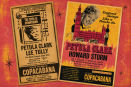 The Copa Years: 1965 - 1966 The Copa Years: 1965 - 1966
Petula's two Copacabana seasons in 1965 and 1966 marked a major turning point in her American career. Her 1965 debut revealed a versatile and sophisticated performer, praised by New York critics for her charm, musical intelligence and wide-ranging repertoire, from pop hits to French chanson and theatre songs. She returned in 1966 as an established star, delivering a polished, confident act that reviewers described as energetic, varied and internationally styled, with standout performances of Our Love Is Here to Stay and Just Say Goodbye. Warner Bros recorded the 1966 engagement for a planned 1967 live album, later cancelled. The tapes resurfaced in the early 1990s and were finally issued in 1993, confirming the
long rumoured Copa recording's existence. There is still more to Petula's Copacabana story waiting to unfold, with more yet to be heard.
Read
more>>
 Unreleased
& Rare Petula Recordings Unreleased
& Rare Petula Recordings
The page presents a fan-curated, non-commercial archival guide to Petula's unreleased and rarely documented recordings. It explains that across her long career, Petula created far more material than was ever commercially issued, including studio demos, rehearsal tapes, withdrawn singles, workshop recordings, concert captures, advertising commissions, and developmental work for stage musicals. Many of these recordings were never intended for release, yet each offers insight into her creative process and artistic evolution. The A–Z series aims to document the existence, context, and significance of these lesser-known works without implying access or circulation. Each weekly instalment highlights the stories, collaborators, and historical background behind these hidden corners of Petula's catalogue, celebrating her legacy while preserving it for research and appreciation.
Read
more>>
|

