HOME
>
MUSIC
Petula
Clark: The Copa Years: 1965 - 1966
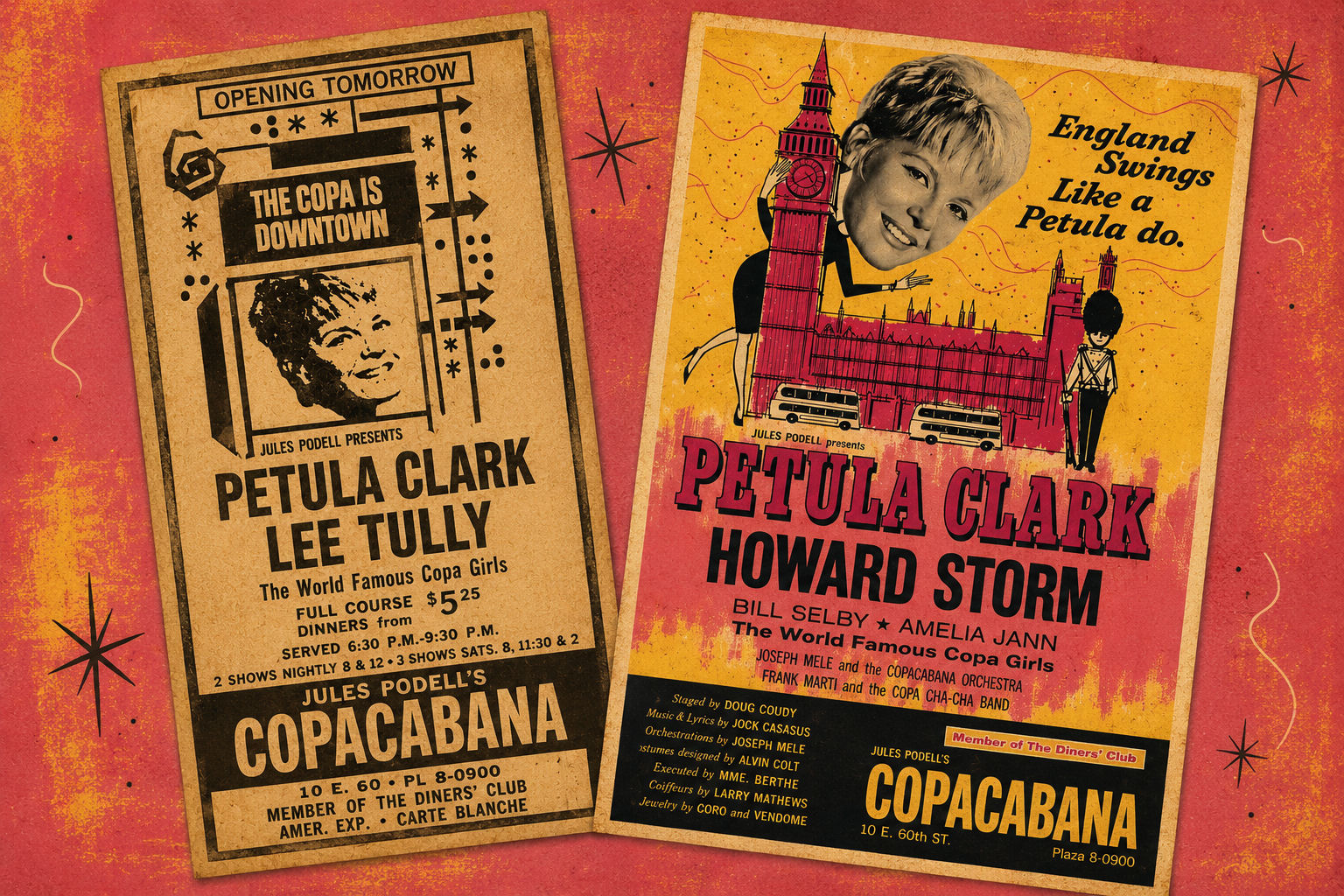
Petula Clark arrived at the Copacabana in October 1965 at a moment when her American fame was still fresh and slightly enigmatic.
Downtown had made her a star almost overnight, yet New York audiences had never seen her in person and had little sense of the breadth of her career in Britain and France. Jules Podell, the
Copa's famously selective impresario, placed her in a full two week engagement from the
14th to the 27th October. She appeared for fourteen nights, two shows every evening at eight and midnight, with three shows on Saturdays at eight, eleven thirty and two in the morning. It was a schedule reserved for performers he believed could truly hold the room.
From the moment she stepped onto the Copa stage, it became clear that New York was meeting not just a pop singer but a fully formed international entertainer. The early reviews set the tone. The New York Journal American described her as a petite bundle of British talent with a surprisingly big voice, one capable of handling rhythm numbers, ballads and Broadway material with equal assurance. They noted that this was her American
live debut and that she approached it with a mixture of polish and warmth that instantly won over the audience. Her personality was singled out as much as her voice. She was bright, engaging and natural, and the paper predicted the show would be a success. Comedian Lee Tully supported the bill, but the spotlight belonged entirely to Petula.
The New York Times carried the most influential notice. Robert Shelton described her appearance as a midtown conquest, a British pop star succeeding in a room traditionally dominated by American nightclub acts. He praised her musical intelligence, her precision and her ability to move easily between chanson, pop and theatre repertoire. What struck him most was her unforced charm. She did not push or posture. She simply performed, and the room leaned in. His tone suggested a kind of discovery. New York was seeing the real Petula Clark for the first time.
Variety, the industry's barometer, was equally enthusiastic. Their review praised her professionalism and her command of the stage. They noted that she shifted between styles without ever losing the audience and that she played the room with the assurance of a seasoned nightclub performer. For bookers and agents, this was the verdict that mattered. Petula was not a novelty booking. She was a legitimate headliner.
Newsday offered the most populist perspective, describing her as captivating and instantly likeable. They emphasised her rapport with the audience and the sense that she was enjoying the room as much as the room was enjoying her. Her humour and conversational ease were highlighted as qualities that made her feel approachable despite her international fame.
The New York World Telegram produced the most expansive portrait. Their feature declared her not a new star but a performer entering a new orbit. The article explained that Americans were only now discovering what British audiences had known for years. Petula
was a versatile, musically literate artist with a distinctive voice and a long career behind her. The piece explored her background, her early fame, her family life and her musical influences. It compared her to Peggy Lee, Patti Page and Doris Day, but stressed that her style was uniquely her own. Photographs spanning her career reinforced the idea that this supposedly new star had in fact been shining brightly for decades.
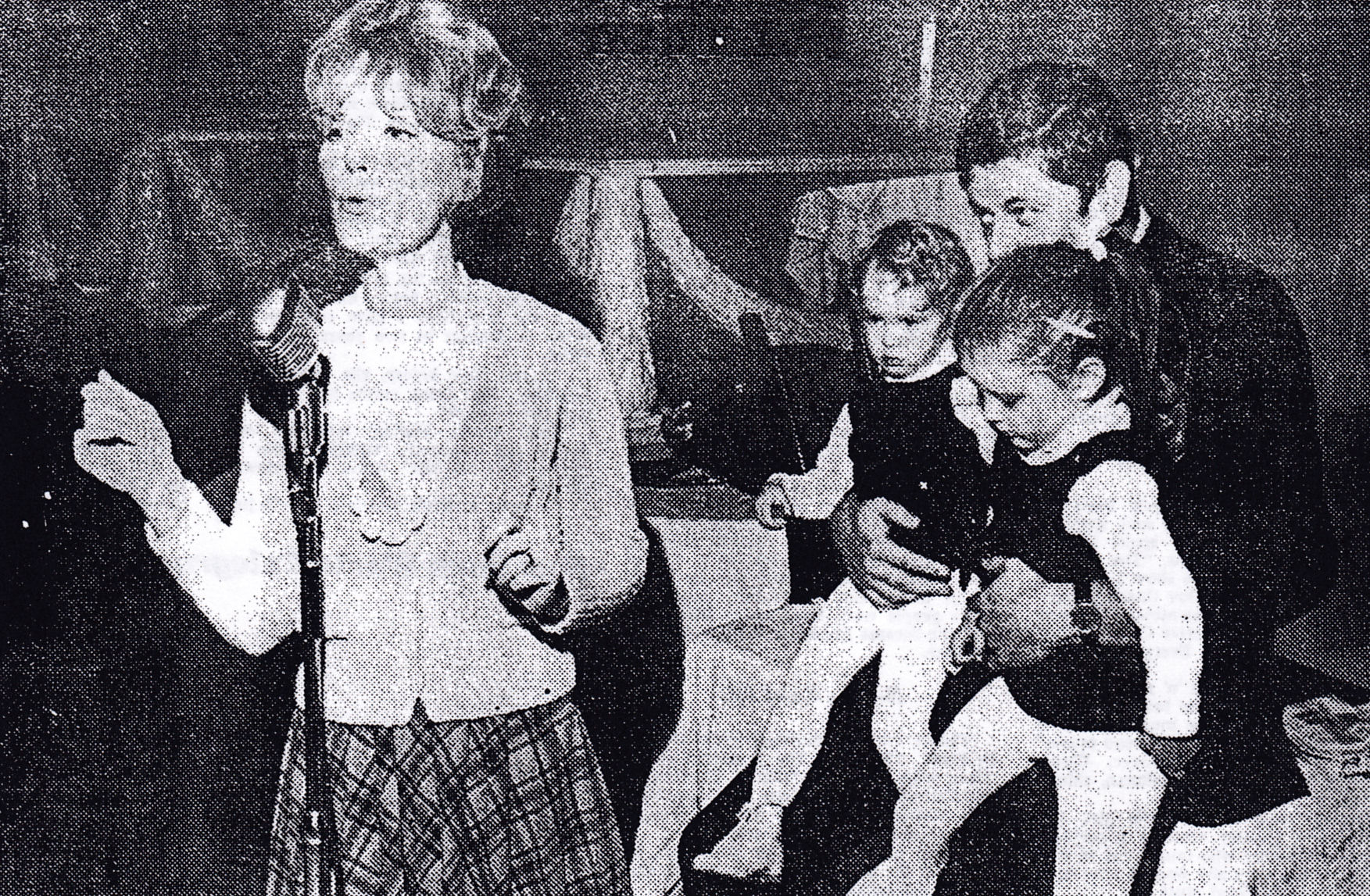
A Newsday photograph
(above) added a rare human moment. It shows Petula rehearsing at the Copa microphone while her husband Claude Wolff sat nearby with their daughters Catherine and Barbara. It softened the glamour of the Copa with a glimpse of domestic life and reminded readers that behind the international career was a young family navigating the whirlwind together.
Across all the reviews, a detailed picture of her 1965 act emerges. Her repertoire was a carefully balanced blend of pop hits, musical theatre, French chanson and unexpected reinterpretations. She sang
Downtown, I Know a Place and Round Every Corner. She included Getting to Know You, a My Fair Lady
medley, a blues inflected version of If I Ruled the World from Pickwick and closed the act with a lively performance of
If I Were a Bell. She paid tribute to her French career with a French lyric version of
Hello Dolly and a tender La Vie en Rose. She surprised critics with a ballad style reading of
I Want to Hold Your Hand, which several reviewers found unexpectedly moving. She also included Irving
Berlin's Only for Americans with new London centred lyrics by Allan Sherman. This was not the act of a pop
star. It was the act of a performer who understood repertoire, pacing and the demands of a nightclub room.
By the end of her two week run, Petula had done more than succeed at the Copacabana. She had redefined herself in the eyes of the American entertainment industry. The 1965 engagement laid the foundation for her triumphant return the following year, the engagement that would be recorded and later partially released. Her 1965 Copa debut was not simply a success. It was a turning point.
Petula returned to the Copacabana on 13th October 1966 for a two week engagement that ran through to the
26th, a year after her triumphant American nightclub debut. In the twelve months since her first appearance she had become an even more established figure in the United States. Her run of hit singles, her growing television presence and her unmistakable voice had made her one of the most recognisable British performers in America. The Copa booking confirmed her status. She was no longer the newcomer who had surprised New York in 1965. She was returning as a proven attraction.
The reviews from the opening nights show a performer who had grown in confidence and command. Variety praised her immediately, noting that she had become a polished, authoritative headliner who handled the room with ease. They described her as bright, energetic and completely in control of her material. Her accompanist for the engagement was Frank Owens, and the paper highlighted the musical rapport between them. The act was described as fast moving and expertly paced, with Petula shifting between languages and styles without ever losing the audience.
Billboard echoed this enthusiasm. They wrote that she had the audience with her from the moment she appeared and that her voice had gained in richness and assurance since the previous year. They singled out her interpretations of her own hits, including
Downtown and I Know a Place, but also noted the strength of her standards. Her reading of
Our Love Is Here to Stay was described as warm and stylish, and her performance of
Just Say Goodbye was praised for its emotional clarity. Billboard emphasised her ability to move from pop to theatre material with complete naturalness, something that had already become a hallmark of her nightclub work.
Cash Box offered a similarly glowing assessment. They described her as a performer who radiated charm and vitality and who had the rare ability to make a large room feel intimate. They noted the multilingual aspect of her act, with Petula moving between English and French repertoire as easily as she shifted between tempos. Her set was described as varied and generous, with a mixture of hits, standards and contemporary material. Cash Box also highlighted her stage presence, describing her as relaxed, confident and thoroughly engaging.
Across all three reviews, a clear picture emerges of the 1966 act. She performed her major hits, including
Downtown, I Know a Place and Round Every Corner, but she also broadened the repertoire with material that showed her musical range.
Our Love Is Here to Stay was singled out repeatedly as one of the highlights of the evening.
Just Say Goodbye was praised for its poise and emotional weight. She included French material, maintaining the international identity that had been so central to her 1965 success. The critics also noted her humour, her conversational ease and her ability to connect with the audience in a way that felt spontaneous and genuine.
What is most striking in the 1966 notices is the sense of consolidation. In 1965 the reviews had carried an element of surprise. New York had not expected a pop star to command the Copa stage with such assurance. In 1966 the tone is different. The critics write as though they are greeting a familiar and welcome presence. They describe a performer who has settled into her American success and who now carries herself with the confidence of someone who knows she belongs on that stage.
The two-week engagement in October 1966 confirmed Petula
as one of the Copa's most successful contemporary attractions. She returned not as a discovery but as an established star, and the reviews show a performer at the height of her powers. The act was polished, varied and musically assured, and the critics agreed that she had grown even stronger since her debut the previous year. Her 1966 Copacabana appearance stands as one of the defining engagements of her American nightclub career, a moment when her international success and her New York acclaim came together with complete confidence.
When Petula returned to the Copacabana in October 1966 she did so at the height of her international success. She had two American number one singles behind her, two Grammy awards and a run of hits that had made her one of the most recognisable British voices in the United States. Her
two-week engagement at the Copa was sold out throughout, and Warner Bros took the opportunity to record her act for a planned live album. The intention was straightforward. A selection of highlights from the engagement would be issued by Pye in London, capturing the atmosphere of her New York triumph and giving fans a sense of her nightclub act at its peak.
The project progressed far enough for Pye to assign a catalogue number, NSPL 18179, and to prepare test pressings. These test pressings demonstrate clearly what the album would have been. The running order, the edits and the chosen performances were all finalised. The album was scheduled for release in
early 1967 and was expected to appear as part of her regular output. For reasons that were never fully explained, the release was cancelled at the last moment. The test pressings were filed away, the tapes were returned to storage and the album quietly disappeared from the schedule.
The timing of the cancellation coincided with the unexpected success of
This Is My Song early in 1967. The single became a major hit in Britain and created an urgent need for a new studio album built around it. In the rush to assemble fresh material the Copacabana project was pushed aside. The live album, once intended to showcase her American nightclub success, was abandoned. Over time it slipped into rumour. Collectors spoke of a lost Copa recording, but no one outside the label had ever heard it and no documentation was publicly available. The existence of the test pressing was known only to a handful of insiders.
The situation changed in the early 1990s when Castle Communications, who were then managing the Pye archives, undertook a detailed review of
its material. During this work the Copacabana tapes were located. It became clear that the recordings were not only real but had survived in excellent condition. The material that had been prepared for release in 1967 was exactly what was issued in 1993. The Sequel CD was not a reconstruction or a modern compilation. It was the album that had been planned, mastered and pressed more than a quarter of a century earlier. The test pressing
confirms this beyond doubt. What listeners finally heard in 1993 was the album that should have appeared in 1967.
The rediscovery of the tapes also revealed something that had not been widely understood. Warner Bros had recorded more than one night. The full extent of the surviving material only became clear later, but it is now known that multiple complete evenings were captured. The 1993 release represents only the highlights originally chosen for the cancelled 1967 album.
Strong vocal performances from the repertoire performed during the engagement remains unheard. Songs that were part of the act but not selected for the original LP still lie in the
Warner Bros. archive, preserved but unreleased.
For that reason the story of the 1966 Copacabana recordings is not finished. What now needs to happen is the release of a complete evening exactly as it was performed. The missing songs, the unedited pacing, the spoken introductions and the full shape of the act would give listeners the true experience of Petula
at the Copa in 1966. The material exists. The tapes survive. The rediscovery in the 1990s proved that nothing was lost. What remains is the opportunity to present the full performance for the first time, restoring an important chapter of her career in the form it was always meant to be heard.
To illustrate what a complete night contained, here is the full set list from one of the recorded
evenings:
Act 1:
1. Put On A Happy Face / I've Seen That face Before
2. My Love
3. I Want To Hold Your Hand*
4. Who Am I*
5. Love Is Here To Stay
6. Come Rain Or
Come Shine
7. I Know A Place
8. Typically English
9. I Couldn't Live Without Your Love
Act 2:
10. My Name Is Petula
11. Call Me
12. Downtown
13. Two Rivers*
14 A Sign Of The Times*
15. Just Say Goodbye*
16. So Nice To Come Home To / Dear Hearts / In A Shanty In Old Shanty Town
*still
waiting to be heard
The Copacabana recordings stand as a vivid record of Petula at her peak, and the possibility of hearing a complete evening exactly as it unfolded remains one of the most valuable opportunities still waiting to be
realised.
|
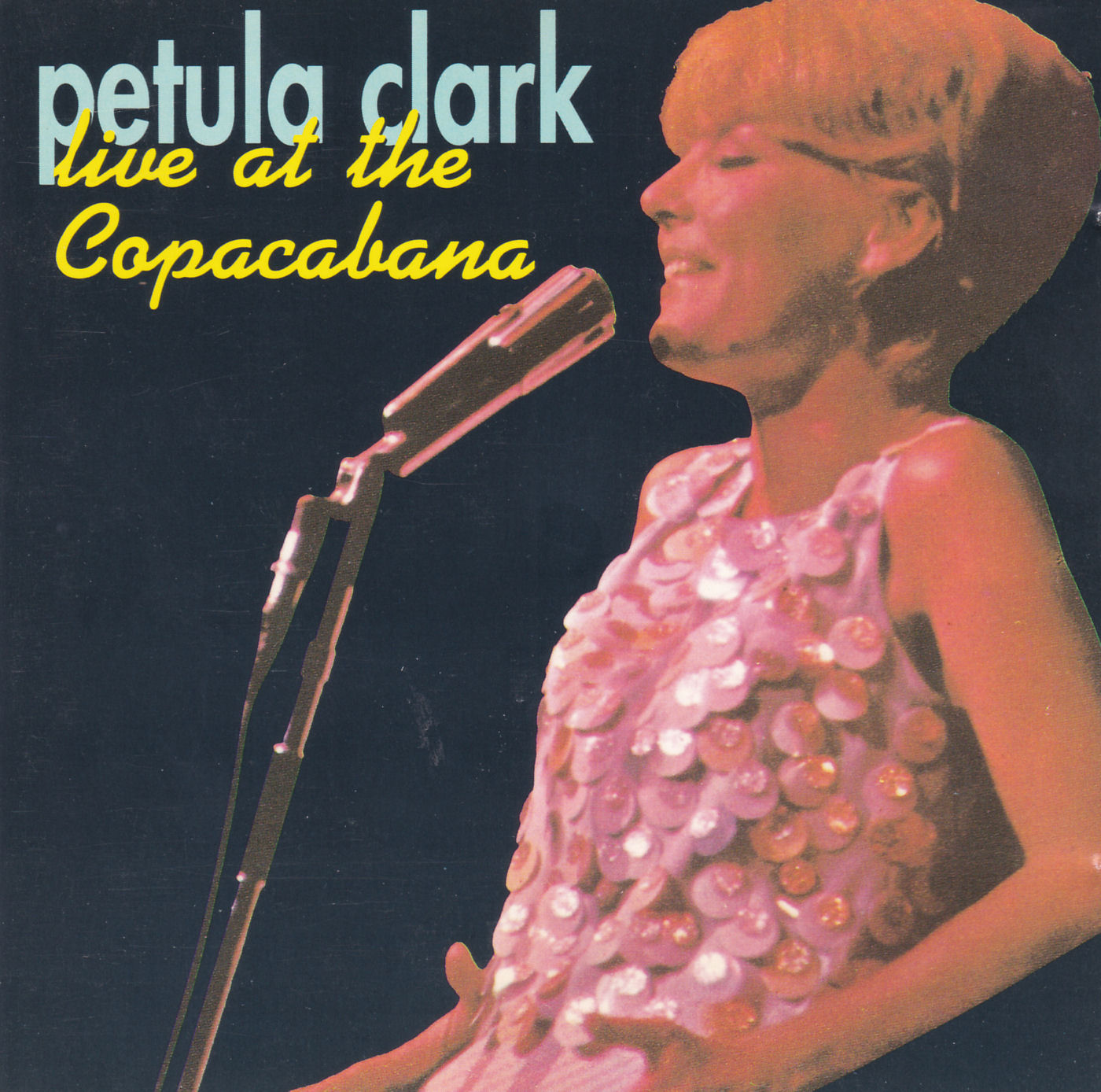
The 1993 Sequel
release
|
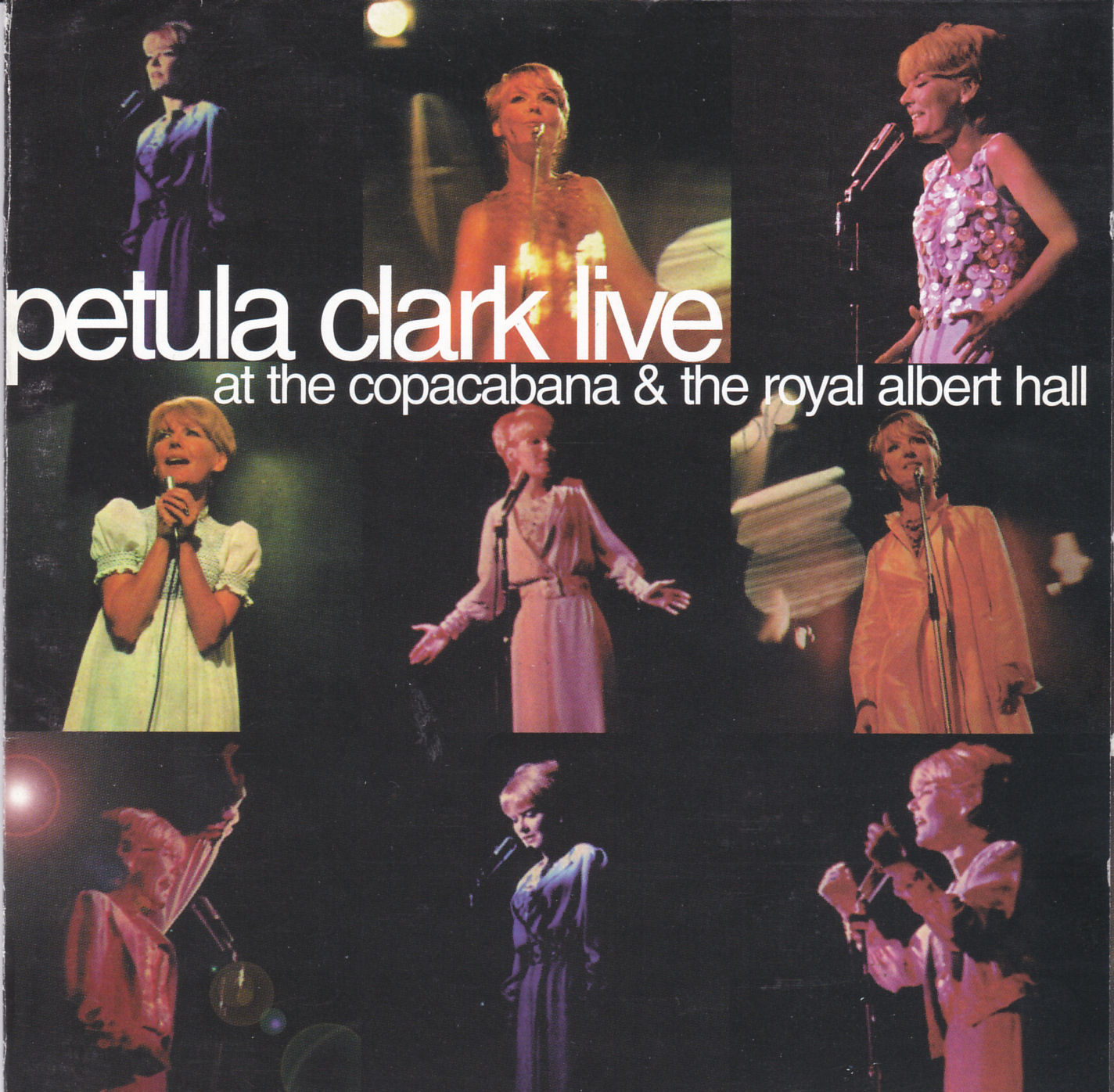
Castle Music and
Sanctuary’s 2001 reissue edition
|
When the rediscovered Copacabana tapes finally appeared in
1993 (above left Sequel NEB CD 653), Record Collector captured the moment with a mixture of surprise and satisfaction. Their news item treated the album as a genuine rarity brought back from obscurity, noting that it had been shelved in the rush surrounding This Is My Song and left dormant for twenty seven years. The accompanying review acknowledged the limitations of mid-sixties mobile recording but praised the period atmosphere, the brassy backing and Petula's light-hearted stage presence, complete with her stories about the pronunciation of her name. The magazine recognised the value of hearing hits like
My Love and I Know a Place in their original nightclub setting, alongside songs she never recorded in the studio. For collectors, the release confirmed that the
long rumoured Copa album had not only existed but had survived intact, and Record Collector's coverage helped cement its status as one of the most significant archival finds in her catalogue.
Questions?
Drop
us an email: info@petula-archives.co.uk

